
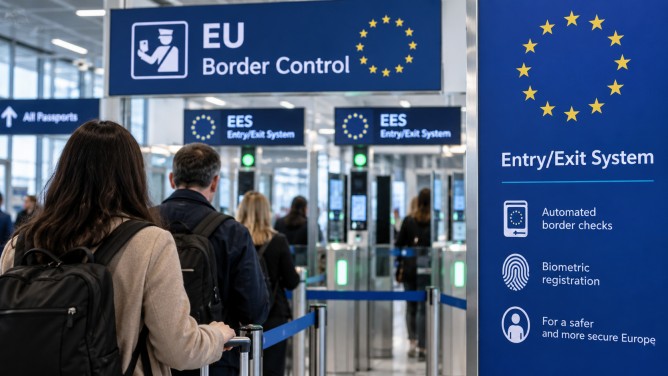
The delay in the full implementation of the European Union’s Entry/Exit System (EES) is causing concerns over potential disruptions at major airports across Europe. Non-EU travelers entering the Schengen area are required to undergo biometric checks, but nine countries, including France, Italy, and Portugal, have postponed the full rollout due to technical and operational challenges.
Originally launched last October, the EES aims to enhance security by recording fingerprints and facial images of visitors. However, countries like Germany, the Netherlands, and Belgium are seeking more time to prepare their airports and border crossings for the system. The International Air Transport Association has previously warned that these delays could lead to long queues, especially during peak travel periods.
Despite these setbacks, the system has already registered approximately 200 million entries and prevented around 70,000 unauthorized entries into the Schengen area. These cases included travelers lacking proper visas, those who overstayed their permitted visit, and individuals with forged documents. Spain has successfully navigated initial hurdles and has fully implemented the EES.
While some locations, such as Eurostar terminals in Brussels and the port of Antwerp, have started biometric checks, many smaller airports are still grappling with capacity and infrastructure issues. Major international airports like Frankfurt and Schiphol are conducting these checks, but the uneven implementation across Europe remains a challenge.
To streamline the process, a pre-travel application called Travel to Europe is being introduced. The app allows travelers to submit their passport details and facial images before arriving at the border, currently operational in Sweden and Portugal, with plans to expand to other countries. This tool aims to reduce wait times and ensure a smoother entry process for non-EU travelers heading to the Schengen area.
