
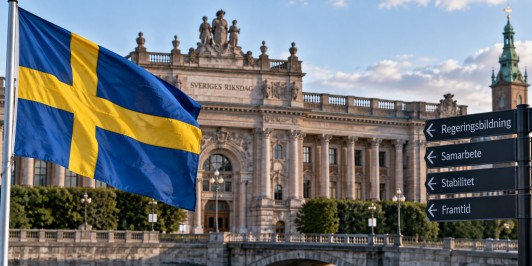
Sweden’s political landscape is in a state of flux as coalition talks commence following a tightly contested parliamentary election. With nearly all votes counted, the centre-left bloc led by the Social Democrats holds a slight edge, securing 176 parliamentary seats against 173 for the right-leaning coalition. The final outcome is pending the inclusion of overseas ballots, expected later in the week.
Magdalena Andersson, the leader of the Social Democrats, is actively engaging in discussions to forge a coalition that could see her party return to power. Simultaneously, outgoing Prime Minister Ulf Kristersson and his centre-right partners are strategizing to maintain their hold on government. The narrow vote margin has injected uncertainty into the process, with both sides exploring various coalition configurations.
The Centre Party emerges as a pivotal player in these negotiations, but internal disagreements cloud its potential cooperation, particularly concerning its stance on working with the Left Party. Holding firm on its principles, the Centre Party advocates for a stable government with a distinct centre-right orientation and refuses to collaborate with what it deems fringe political elements. Meanwhile, several left-wing parties are advocating for a governmental shift, cautioning that a protracted stalemate could necessitate another election.
As coalition talks unfold, the Sweden Democrats, who previously backed the right-wing government, have seen a drop in support and are unlikely to participate in the next government. Nonetheless, their influence persists as their views on immigration, integration, and crime continue to shape the broader political discourse. Kristersson is keeping his options open, awaiting the final election results, while his allies, the Moderates, Liberals, and Christian Democrats, face the challenge of securing a parliamentary majority, having ruled out any alliance with the Social Democrats.
The newly elected parliament is set to convene on September 28, with the earliest possible vote on a prime minister slated for the following day. Should the process of electing a prime minister stall, Sweden may face the prospect of another election. Given the past, where forming a government took 37 days post-2022 elections and 134 days following the 2018 elections, the current negotiations could extend for weeks or months. With no clear majority, the roles of the Centre and Left parties are crucial in shaping Sweden’s next government.
